
Results are loud. Probability can seem illogical and irrelevant once we know an outcome.
In betting markets, the loudest thing that happens on any given day is the final scoreline. A player either clears their line or they don’t. A bet wins or it loses. The temptation is to judge the quality of the bet purely by the result.
But results don’t determine whether a bet was good. Price does.
AFL Opening Round provided a perfect example of how a good bet can lose and a bad bet can win.
The two plays:
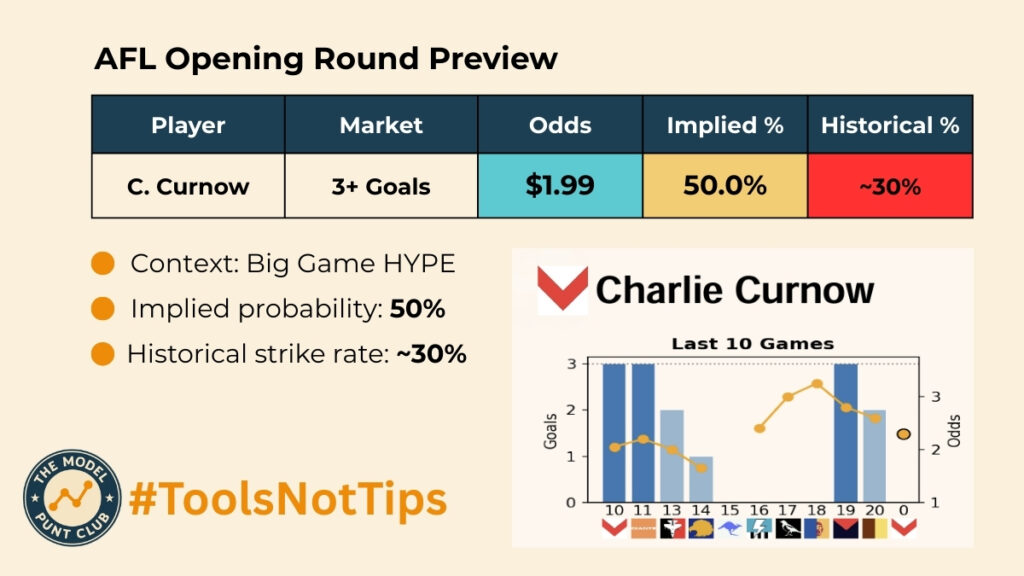
- Charlie Curnow 3+ goals — $1.99
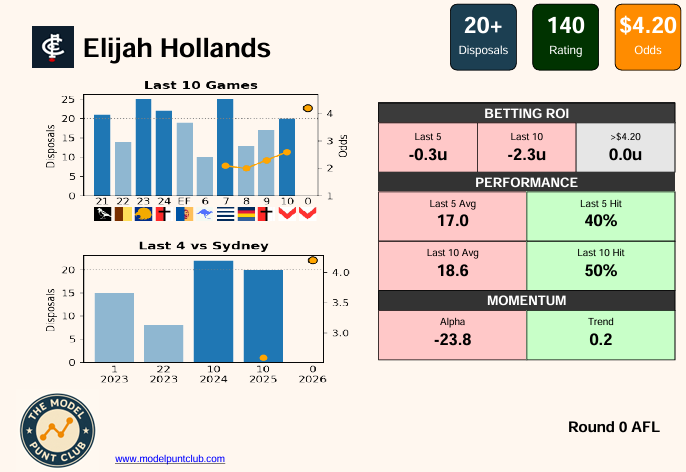
- Elijah Hollands 20+ disposals — $4.20
The outcomes?
Curnow kicked 3 goals.
Hollands finished with 19 disposals.
If you judged purely on the result, the takeaway would be simple: Curnow was the better bet, but once we look at the numbers, the story changes.
Probability vs Price
To illustrate the concept clearly, assume both players have a true probability of 50% of hitting their line.
That assumption actually helps Curnow and hurts Hollands.
Historically, Curnow hitting three goals is closer to ~30%, while Hollands clearing 20 disposals has been closer to 50% or higher. But to keep the comparison simple, we’ll equalise them at 50%.
Even with that generous assumption for Curnow, the expected value calculation tells the story.
Expected Value (EV) formula
Expected Value = (Probability of Win * Profit of Win) – (Probability of Loss * Stake)
Example 1: Curnow $1.99 at 50%
Stake: 1 unit (u)
Profit if win: 1.99 – 1 = 0.99u
Expected Value: (0.50 * 0.99) – (0.50 * 1)
EV = 0.495 – 0.50
EV = -0.005
This is essentially break-even, but technically slightly negative. The market price is fair at best and possibly slightly inflated.
Curnow winning the bet doesn’t change that.
Example 2: Hollands $4.20 at 50%
Stake: 1 unit
Profit if win: 4.20 – 1 = 3.20u
Expected Value: (0.50 * 3.20) – (0.50 * 1)
EV = 1.60 – 0.50
EV = +1.10u
This is massive positive expected value.
At a 50% probability, a $4.20 price is dramatically misaligned.
Even though Hollands finished with 19 disposals and the bet lost, the pricing was still exceptional.
The Result vs The Process
This is the uncomfortable truth about betting.
The best bets lose all the time and sometimes the worst bets win.
If Hollands picks up one more disposal late in the game, the narrative flips instantly. But the quality of the bet doesn’t change based on one stat.
The edge existed before the game started and that’s the only moment that matters.
Why Results Mislead Punters
Human psychology is wired to evaluate outcomes.
If something wins, it feels correct.
If something loses, it feels wrong.
But betting markets are built on probability distributions. A 50% outcome will still fail half the time, even if the price is completely wrong.
In fact, mispriced bets often lose frequently because they sit in volatile probability ranges. That’s why short-term results can be misleading.
The Model Punt Club Approach
At Model Punt Club, we focus on one thing:
Probability vs price.
Not narratives – Not highlight reels – Not who scored last week.
We evaluate:
- Historical strike rates
- Market implied probability
- Role stability
- Price expansion caused by narrative bias
The goal isn’t to predict the result of a single game.
The goal is to identify prices that underestimate true probability.
Over time, that gap compounds.
The Bigger Lesson
In Opening Round of the AFL:
- Charlie Curnow 3+ goals at $1.99 won
- Elijah Hollands 20+ disposals at $4.20 lost
But the pricing told a different story.
One bet was fairly priced at best and the other carried a significant edge.
That’s the difference between betting on outcomes and betting on probability.
Sometimes the market is right. Sometimes the market is wrong.
The job is to recognise the difference before the game starts.
Access the full AFL & NRL player prop data.
Every game-day sheet. Every listed market.
400+ games covered each season.
Bet Smarter. Join the Club.
This content is for educational and entertainment purposes only. Not financial advice. Gamble responsibly.